If you run a restaurant brand in 2026 and still think “allergen rules are just for CPG labels,” you’re officially behind.
Over the last few years, the U.S. has quietly built a patchwork of allergen laws that now hit menus, grab-and-go cases, training, and even your back-of-house posters. With California’s new menu law and New York’s premises-packed labeling rule, we’ve crossed an inflection point.
After 19 years in this industry, watching the allergen landscape evolve feels like déjà vu. It mirrors the chaos of the Calorie and Sugar menu-labeling era, when, by 2018, more than 20 different laws were in effect, each with its own disclosures, posting rules, deadlines, and location thresholds. That fragmentation created operational havoc until 2019, when the Nutrition Labeling of Standard Menu Items rule finally standardized requirements at the federal level requiring restaurants with 20+ locations to only adhere to the menu labeling rule. This labeling standard brought much-needed consistency to the entire industry.
As EveryBite starts the new year, I wanted to create a 2026 allergen bills cheat sheet to help the industry to not only comply, but also add some context to why we are here and the business benefitting opportunities that come with menu transparency.
This cheat sheet will show:
What bills exist today
Who they apply to
And what smart operators are doing about it
The Federal Baseline: What’s Already “Baked In?”
Even before the state wave, three federal pieces set the ground rules:
1. FALCPA – Food Allergen Labeling and Consumer Protection Act
In force since 2004, FALCPA requires most packaged foods to clearly identify the (original) 8 major allergens in plain English.
2. FASTER Act – Sesame Joins the List
As of Jan 1, 2023, sesame became the 9th major allergen under the FASTER Act, meaning packaged food manufacturers must now label sesame just like peanuts or milk.
3. FDA 2022 Food Code – Unpackaged Food in Restaurants
The 2022 Food Code (which states adopt into their own codes) makes clear that restaurants and other foodservice operations must be able to provide accurate information about the 9 major allergens in unpackaged foods, what you actually serve on the plate.
Federal law still doesn’t say: “Dear restaurant, you must print allergens on every menu line item.” That jump is happening at the state level.
THE Two Game-Changers for Foodservice in 2026
California: SB 68 – Allergen Disclosure for Dining Experiences (ADDE) Act
California is the first state to explicitly require allergen disclosure on restaurant menus.
What it does
SB 68 (the ADDE Act) was signed on October 13, 2025.
Requires food facilities with 20 or more locations that are already subject to federal menu labeling rules to provide written notification of the 9 major allergens for each menu item.
Applies to physical menus, digital menus, menu boards, and QR-code experiences.
When it hits
Takes effect July 1, 2026
Why it matters
It’s the first statewide requirement saying: “You must show allergens at the menu level.”
If you’re a chain with 20+ locations and a presence in California, you now have a hard, dated requirement that will drive your entire menu and tech stack.
New York: A6558 / S5381 – Premises-Packed Allergen Labels
New York attacked a different blind spot: deli, bakery, and café grab-and-go.
What it does
Requires every food establishment to label prepackaged food prepared and prepacked on the same premises with a written allergen notification on the package or its label.
Covers classic items like:
Deli sandwiches in clamshells
Bakery boxes, cut cakes, muffins
Café grab-and-go salads and snacks
When it hits
Takes effect in November 2026.
Why it matters
NY is now the first U.S. state to require allergen labels on premises-packed foods—not just factory-packaged CPG.
If you have in-store bakeries, delis, or fresh grab-and-go programs, this one is huge.
The “Awareness States”: Notices, Posters & Training
Beyond CA and NY, a group of states quietly created an allergen compliance baseline for restaurants through menu notices, posters, and training. Together, they set expectations for the rest of the country.
Massachusetts – The Original Model
Requires a menu or menu-board statement like: “Before placing your order, please inform your server if a person in your party has a food allergy.”
Requires a staff-area food allergy awareness poster.
Requires allergen training for certified food protection managers.
Rhode Island
Mirrors Massachusetts:
Menu allergy notice
Kitchen allergen poster
Manager allergen training.
Connecticut – PA 23-115
Requires a state-developed allergen poster in the staff area.
Requires allergen notice on menus and menu boards, including digital menus used for delivery or takeout.
Michigan
Requires restaurants that serve unpackaged food to post an allergy advisory on menus, menu boards, or at point of order.
Requires a food allergy awareness poster; allergen training has shifted from strict mandate to strong recommendation.
Maryland
Requires a Food Allergen Awareness poster in food establishments—part of standard compliance poster bundles.
Illinois
Under its food allergy laws, it requires allergen awareness training for managers and display of a food allergy awareness poster in the kitchen or visible area.
Texas – Sergio Lopez Food Allergy Awareness Act (SB 812)
Signed into law in 2023; fully in effect with training requirements kicking in Sept 1, 2024.
Requires food establishments to post an allergen-awareness poster.
Requires that all state-approved food handler and food manager training programs include food allergy content.
New Jersey
Includes a Food Allergy Awareness for Food Workers poster as part of the state posting requirements for foodservice operations.
Virginia
HB 2090 (2015) requires the state to build food allergy awareness into restaurant training regulations.
A 2025 bill that would have required menu-level allergy notices (SB 1350) was vetoed, so there is still no statewide menu-notice requirement—only training expectations.
Local Rules: New York City & Saint Paul, MN
Both require posted allergen information (often multilingual) in foodservice establishments, further signaling that allergen awareness is no longer optional.
What This Means for Restaurant Leaders in 2026
If you zoom out, here’s the pattern:
Allergens are moving from the back office to the menu.
California SB 68 and New York’s premises-packed law are the first, but almost certainly not the last.
Posters + training are becoming table stakes.
MA, RI, CT, MI, MD, IL, TX, NJ, VA, and key cities already require some mix of training + signage + menu notices.
Digital is no longer “nice to have”—it’s the only scalable solution.
Once you need to show allergens across printed menus, digital menus, QR flows, kiosks, and third-party ordering, static PDFs and spreadsheets stop working.
You need a single source of truth for recipes, ingredients, and allergens.
The risk has changed.
Non-compliance is no longer “we’ll fix our poster at the next inspection.”
With menu-level requirements and premises-packed labels, errors now show up right in front of guests, regulators, attorneys, and journalists.
A Practical checklist for 2026+
Here’s how I’d advise any multi-unit brand to think about the next 12–24 months:
1. Map your footprint to laws.
Do you operate in California, New York, Texas, New England, Mid-Atlantic, or big metros like NYC?
For each state/city, list: “Do we need menu notices? Posters? Training? Menu allergen disclosure? Premises-packed labels?”
2. Build (or choose) a central recipe + allergen system.
Store recipes, ingredients, supplier data, and allergens in one place if you're looking for recipe analysis software, check out FoodCalc
Ensure you can push updates out to: printed menus, QR experiences, kiosks, online ordering, and grab-and-go labels.
3. Standardize training and scripts. I love MenuTrinfo for all things allergen training.
Make sure every manager knows:
How to handle “I have a food allergy” conversations
Where to find accurate allergen info
How to respond if they don’t know the answer
4. Treat SB 68 + NY premises-packed as a preview, not an exception.
Expect copycat bills in other states.
The operators who treat this as a guest experience and revenue opportunity (not just a compliance chore) will win: more trust, more repeat visits, more digital engagement.
Personalized Guest Experiences = Higher Revenue
Compliance isn’t the endgame, it’s the foundation.
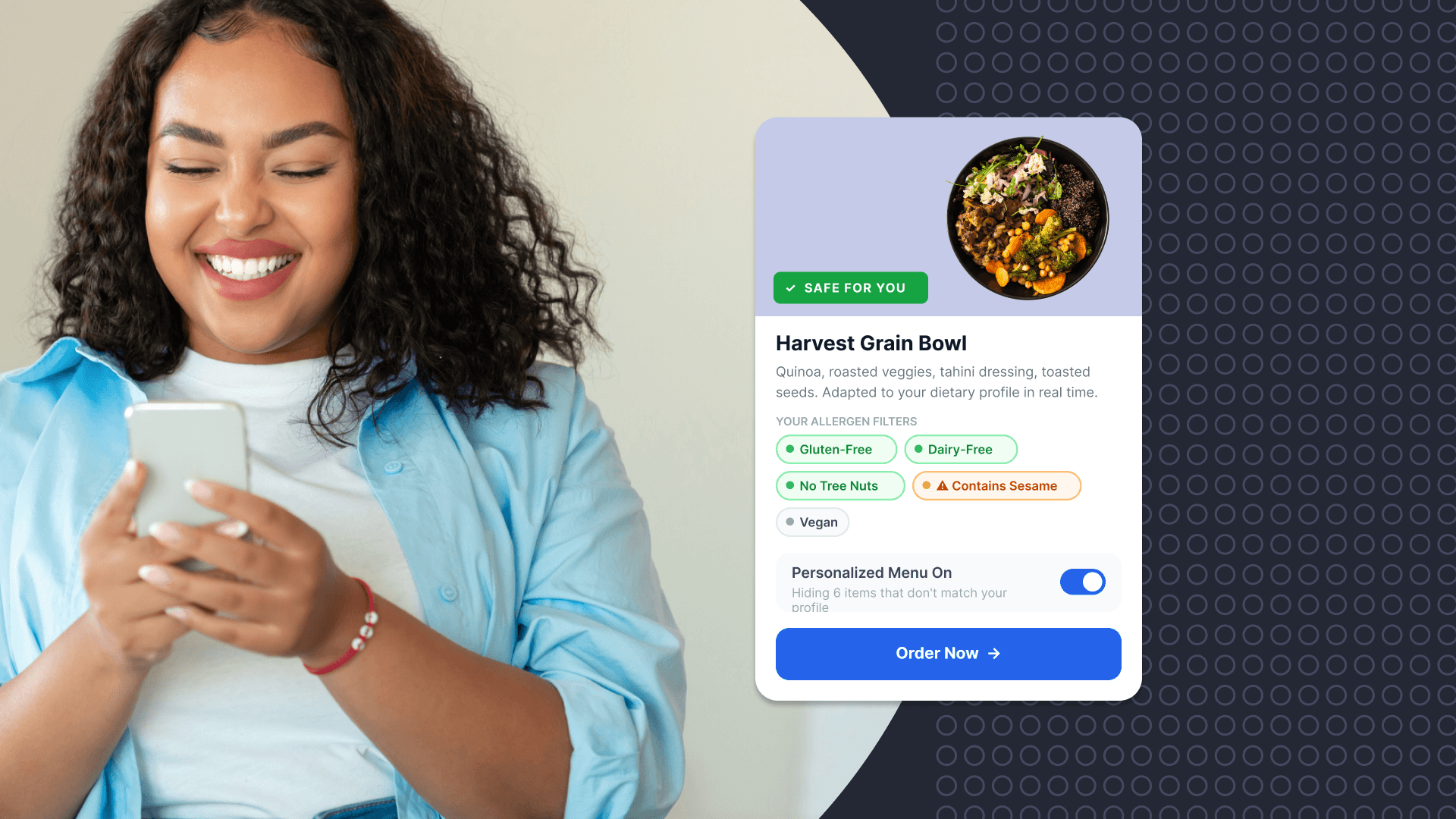
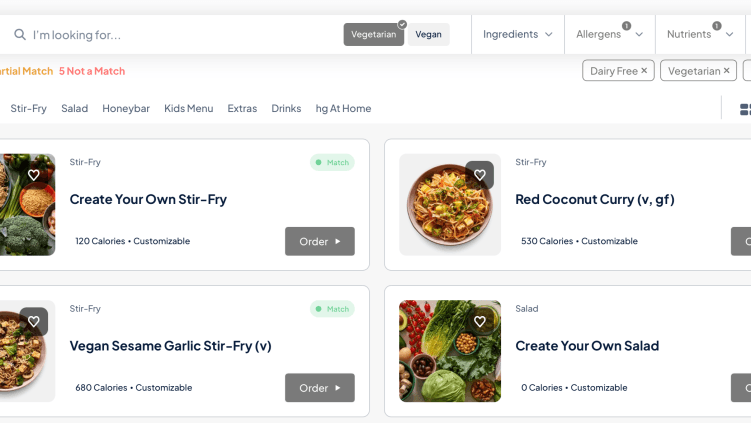
SmartMenu transforms allergen data into a personalized dining experience:
Guests filter menus by allergens, diets, macros
SmartMenu makes 1:1 dish recommendations based on their profile
Brands see higher conversion, average order value, and loyalty
Our data across thousands of locations shows that guests who interact with SmartMenu:
Spend more
Explore more dishes
Return more often
And if you're an Olo customer, you can now unlock personalized ordering that boosts conversion and AOV, while delivering the future of menus that are transparent, data-powered, and built for every guest.
My final thoughts:
At the end of the day, transparency isn’t a cost center, it’s one of the highest-ROI investments a restaurant brand can make. When guests feel understood and safe, they spend more, return more, and trust your brand more. SmartMenu turns allergen data into revenue drivers: higher conversion, larger checks, smarter upsells, and more loyal diners. Compliance may be the mandate, but personalized profitability is the reward, as Noah Glass has long championed.
Reach out to learn more about how EveryBite helps multi-unit brands turn compliance into guest loyalty drivers, frequency of visits and revenue.